You have thought about succession. Maybe not formally, but the thought has crossed your mind. You are not 30 anymore. The business you built over 15 or 20 years is successful, valuable, and entirely dependent on you being in the building every day.
You know the legal steps. Transfer the shares. Update the contracts. Restructure the tax situation. Your lawyer has mentioned it. Your accountant has a checklist.
But here is the question nobody has asked you: if you handed the keys to your successor tomorrow, could they actually run the business?
Not legally. Operationally. Could they find the right files? Could they follow the processes? Could they make the decisions you make every day based on what is written down, rather than what lives in your head?
For most businesses, the honest answer is no. And that is not a legal problem or a financial problem. It is an operational problem. The same operational problem this entire guide library has been addressing from the first page.

Succession is not a legal event. It is an operational state. A business that is operationally ready for succession is a business that runs on structure instead of willpower.

The numbers behind the wave
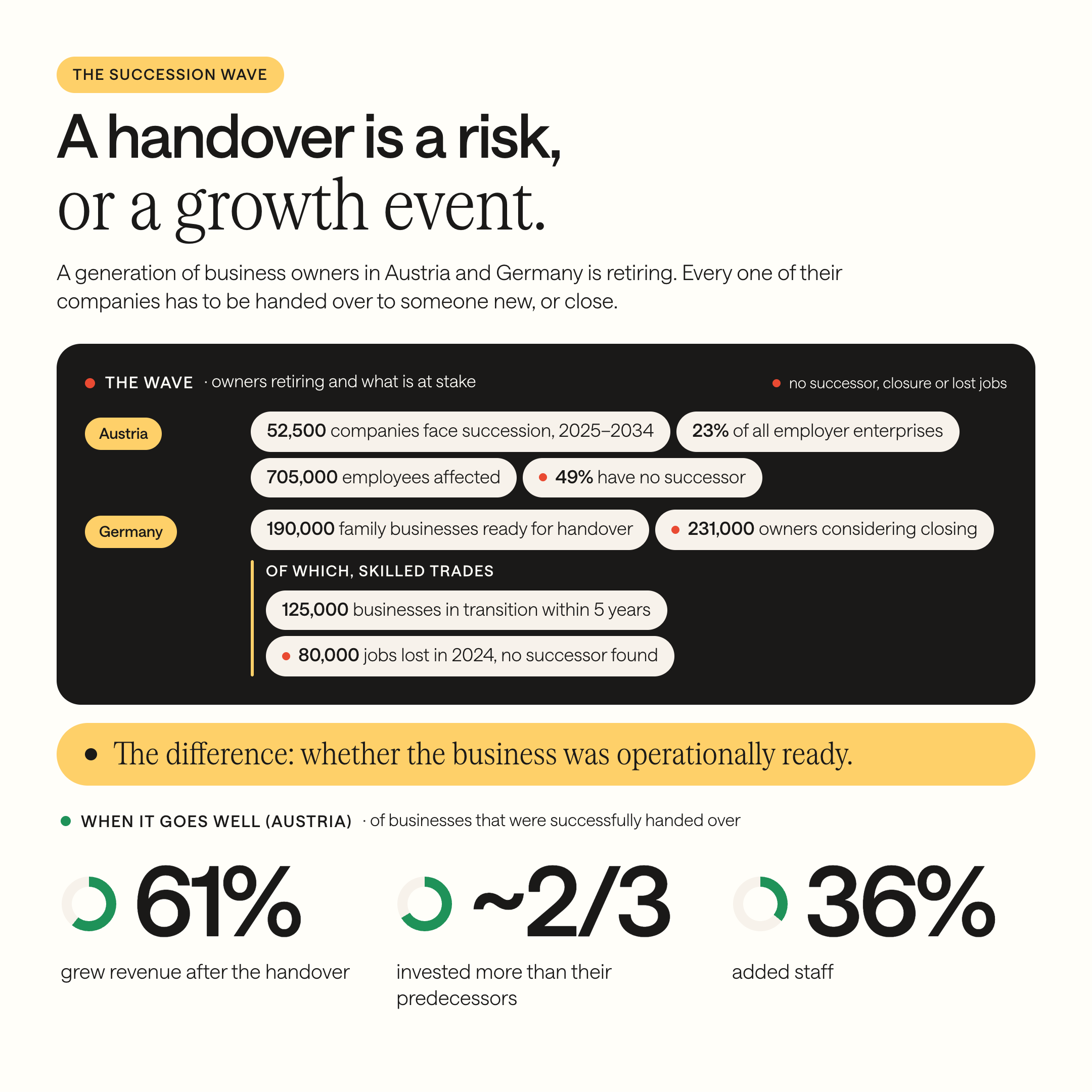
Austria’s Federal Ministry of Economic Affairs reports that 52,500 companies face succession between 2025 and 2034. That is 23% of all employer enterprises, affecting roughly 705,000 employees. 49% have no successor identified (ÖGIZIN/Spectra KMU-Studie 2025).
In Germany, the IfM Bonn calculates that 190,000 family businesses are ready for handover in the period through 2026. KfW Research’s Nachfolge-Monitoring Mittelstand 2025 found that 109,000 owners per year plan to hand over their business through end of 2029, and 114,000 per year are considering closing their business entirely through end of 2029. 57% of all SME owners are now 55 or older, and only about half of those seeking succession have good prospects. Many of those plans will not materialize, because the businesses are not ready.
In skilled trades, 125,000 businesses face generational transition in the next five years. An estimated 80,000 jobs were lost in 2024 because owners found no successors and chose to close.
These numbers get cited in every succession article. What does not get cited is the operational reality behind them: a successor who takes over a business where the processes are undocumented, the data is scattered, and the critical knowledge sits in the outgoing owner’s head is not inheriting a business. They are inheriting a puzzle with missing pieces.
The inverse is also true, and far more useful to know. According to data published in the WKÖ Factsheet Nachfolge, 61% of successfully transferred Austrian businesses grew revenue after the handover, 60% invested more than their predecessors, and 36% added staff. Done well, succession is not a threat. It is a growth event. The variable is whether the business was operationally ready when the handover happened.
Why is legal preparation not enough for business succession?
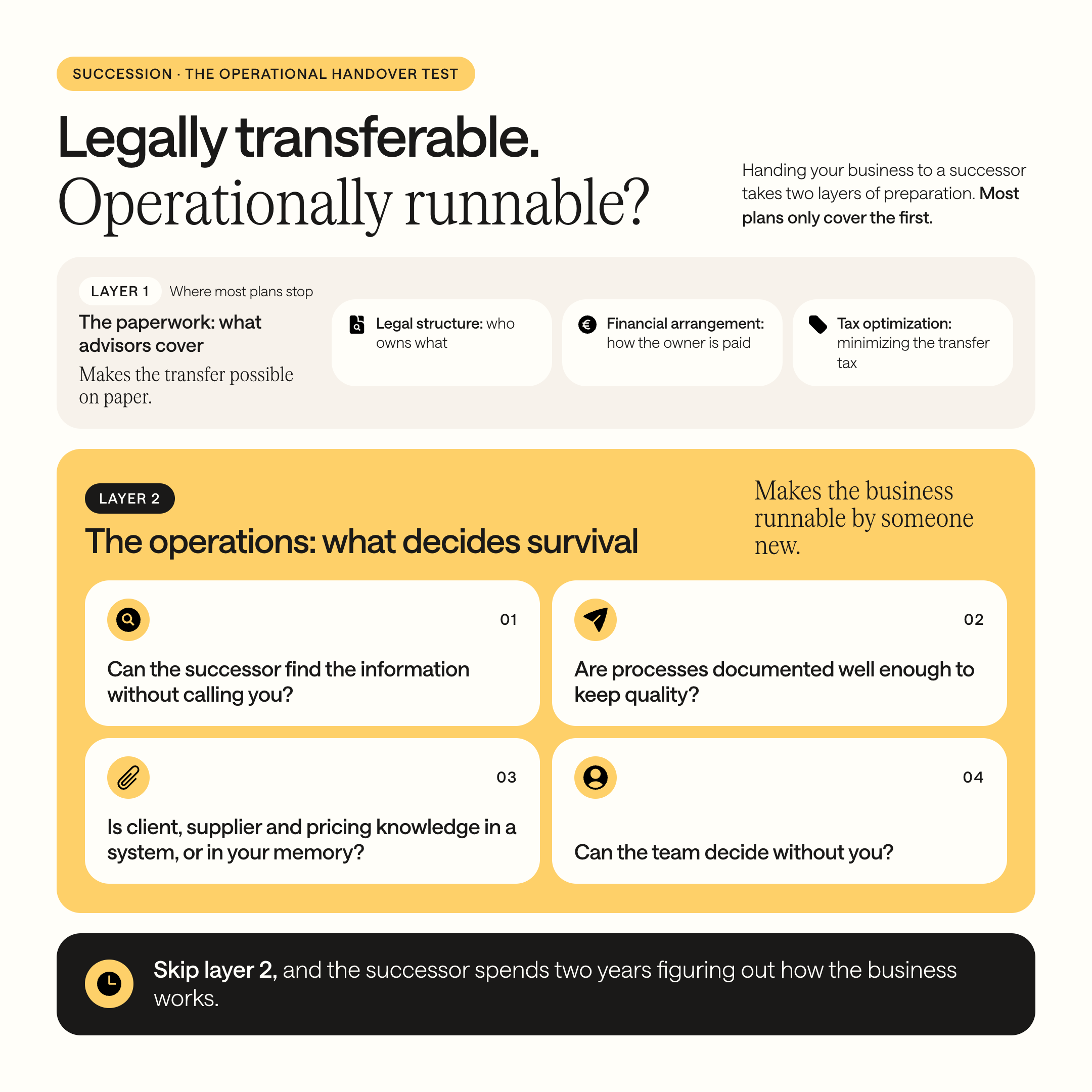
Every succession advisory focuses on three things: the legal structure (who owns what after the transfer), the financial arrangement (how the outgoing owner is compensated), and the tax optimization (how to minimize the transfer tax burden).
These matter. But they are the paperwork of succession. They make the transfer possible on paper. They do not make the business runnable by someone who was not there for the last twenty years.
The operational dimension of succession asks different questions entirely:
Can the successor find the information they need to run the business without calling the previous owner every day? Are the processes documented well enough that the team can maintain quality and consistency without the founder’s personal oversight? Is the institutional knowledge (client history, supplier relationships, pricing logic, quality standards) in a system, or is it in one person’s memory? Can the team function independently, or do they depend on the founder for approvals, decisions, and exceptions that were never codified into rules?
The businesses that succeed through a handover are the ones where the answers to these questions were yes before the succession started. The ones that fail are the ones where the successor spends the first two years trying to figure out how the business actually works, while the business slowly loses what made it valuable.
How do I test if my business can run without me?
This is not a legal checklist. It is an operational readiness diagnostic. Answer each question honestly.
- Could a successor find every active client’s current status, contract terms, and contact details in one system, without asking anyone?(Yes / Partially / No)
- Are your core business processes (sales, delivery, invoicing, complaints, onboarding) written down in a format someone new could follow?(Yes, current / Partially / No)
- If the three most senior people in the company left simultaneously, how long would it take for the business to stabilize?(Weeks / Months / It might not)
- Does someone other than you know the logic behind your pricing, your supplier choices, and your client prioritization?(Yes, it is documented / A few people know informally / Only I know)
- Can your team make day-to-day operational decisions without your personal approval?(Yes, clear authority exists / Sometimes, but many things require me / Almost everything goes through me)
- Is your financial reporting automated and current, or does someone assemble it manually from multiple sources?(Automated and current / Semi-automated / Manual and often outdated)
- Do you have documented roles and responsibilities, or does the team’s actual work differ significantly from any written description?(Documented and accurate / Partially / No written descriptions, or they are outdated)
- If you stopped answering your phone for a month, would the team know how to handle exceptions, escalations, and unusual situations?(Yes, guidelines exist / For some situations / They would be lost)
- Is your client relationship history (key conversations, agreements, preferences, issues) in a system, or in your email and memory?(In a system / Partially / In my inbox and my head)
- Could you describe, in writing, everything a successor would need to know to run this business, and would it fit in less than 50 pages?(Yes / I think so, but it has never been written / No, it would take months to document)
Reading your results
Mostly “Yes” answers: Your business is operationally ready for succession. The handover will be about leadership and relationships, not about reconstruction. You are in the minority.
Mostly “Partially”: The foundation exists but has gaps. The most common profile: some processes are documented, some knowledge is shared, but critical areas still depend on specific people (often you). These gaps are fixable within months, not years.
Mostly “No”: Your business is legally transferable but not operationally runnable by someone who was not there from the beginning. This does not mean succession is impossible. It means the operational preparation needs to start now, well before the handover date.

We built an interactive operational health assessment that covers all six dimensions of operational readiness, including the people and knowledge dimension that drives succession preparedness. Takes five minutes. Take the interactive operational health test here →
The connection to everything else in this library
Operational succession readiness is not a separate topic. It is the sum of every other dimension this library covers.
Data & Information (Guide 5): can a successor find the right information? Or will they spend the first six months trying to locate files, reconcile spreadsheets, and figure out which version of the client database is current?
Processes (Guide 6): are the workflows documented? Or will the successor have to reverse-engineer how the business operates by watching people and asking questions?
People & Knowledge (Guide 4): is the institutional knowledge in systems, or in people’s heads? The founder’s head is the biggest knowledge silo of all. When that head leaves the building permanently, what goes with it?
Communication (Guide 8): does information flow through structured channels, or through the founder’s personal WhatsApp and email? A successor cannot inherit informal communication patterns.
Tools & Systems (Guide 3): are the tools connected and serving the business, or has the founder built personal workarounds that only they understand?
Readiness to Change (Guide 9): can the team adapt to a new leader, new approaches, and new systems? Or have they been operating in the founder’s shadow for so long that independence feels impossible?
Every guide in this library is a guide to succession readiness. You just do not have to be planning a succession to benefit from the work.
Succession readiness is AI readiness. The foundation is the same.
One more connection worth making. The same operational foundation that makes a business ready for succession is the foundation that makes it ready for AI.
Both require documented processes. Both require structured data. Both require knowledge that lives in systems rather than in one person’s head. Both require a team that can function independently.
A business that is operationally ready for succession is a business where AI has clean data to work with, documented processes to learn from, and organized knowledge to draw on. The work is the same. The reasons are different. The outcome is a business that is more resilient, more valuable, and more capable, regardless of whether succession is five years away or fifteen.
For the full picture on AI readiness and data quality: 95% of AI Projects Deliver Zero ROI. Here’s Why, and What to Fix First.
61% of successfully transferred Austrian businesses grew revenue after the handover. 60% invested more than their predecessors. 36% added staff. Done well, succession is not a threat. It is a growth event. The variable is whether the business was operationally ready. (WKÖ Factsheet Nachfolge)
Where to start
You do not need to be planning a succession this year to benefit from this test. The operational readiness it measures is the same readiness that makes your business more efficient, more resilient, and more valuable every day.
Step 1: Run the ten-question test above. Be honest.
Step 2: Identify the three weakest areas. These are your operational vulnerabilities, succession or not.
Step 3: Start with the one that causes the most daily pain or carries the highest risk. For most founders, it is either process documentation (the business runs on habits nobody has written down) or knowledge concentration (critical knowledge lives in one or two heads, usually including theirs).
Step 4: Read the relevant guide from this library and start the work.
The goal is not to prepare for a specific handover date. The goal is to build a business that could survive one. That distinction matters, because a business that could survive a handover is also a business that runs better every day, grows more easily, and does not require its founder to answer WhatsApp at 11pm.
Ready to document the knowledge that currently lives in people’s heads? Read next: If Your Best Employee Quits Tomorrow, What Breaks?
Want to start mapping the processes your successor would need to understand? Read next: How to Map a Business Process, Even If You Have Never Done It Before
Your Next Step
Succession is not a legal event. It is an operational state. A business that is operationally ready for succession is a business that runs on structure instead of willpower. You do not need to be retiring next year to want that.
You now have the ten-question test and a clear map of what connects succession readiness to every other dimension of operational health. You can assess your readiness this afternoon.
Building the operational foundation for a business that can run without its founder takes sustained, focused work. Documenting processes, structuring data, transferring knowledge from heads to systems, connecting tools, training the team.
If you want to build a business that runs on structure, not on you, we start with a structured audit across all six operational dimensions. Then a roadmap from founder-dependent to founder-optional. Sprint-based delivery with real progress every few weeks. We stay after the build.
Ready to find out whether your business could run without you? Book a structured operations call here.
Whether you take this on yourself or hand it to us, we hope this guide makes you think about your business not just as something you built, but as something you want to last.
FAQ
What is operational succession readiness?
Operational succession readiness measures whether a business can actually be run by someone who was not there from the beginning, not legally, but practically. Can a successor find the right files, follow the processes, and make daily decisions based on what is documented rather than what lives in the founder’s head? 52,500 Austrian companies face succession by 2034, and 49% have no successor identified (ÖGIZIN/Spectra KMU-Studie 2025).
Why is legal preparation not enough for business succession?
Legal preparation transfers ownership. Financial preparation compensates the outgoing owner. Neither makes the business runnable by someone new. A successor who inherits undocumented processes, scattered data, and critical knowledge trapped in the departing owner’s memory does not inherit a functioning business, they inherit a puzzle with missing pieces. The operational dimension of succession is what determines whether the business survives the handover.
Do I need to be planning retirement to benefit from succession readiness?
No. The operational readiness that makes a business succession-proof is the same readiness that makes it more efficient, more resilient, and more valuable every day. A business that could survive a handover also runs without the founder answering WhatsApp at 11pm, grows more easily, onboards new employees faster, and is worth more to any buyer, partner, or investor at any point.
How are succession readiness and AI readiness connected?
They require the same foundation. Both depend on documented processes, structured data, knowledge stored in systems rather than in individuals, and a team that can function independently. A business that is operationally ready for succession is already a business where AI has clean data to work with, documented processes to learn from, and organized knowledge to draw on. The work is identical: the reasons are different.



.jpeg)


