Your Three Most Important People Don't Show Up on Monday. What Breaks?
If you hesitated, that hesitation is the answer. You built something real. Years of long days, tough calls, and relentless work. But somewhere between "we figured it out as we went" and "we now have 80 employees," the way your business runs stopped being a conscious choice. It became a collection of habits, workarounds, and people who hold the whole thing in their heads.
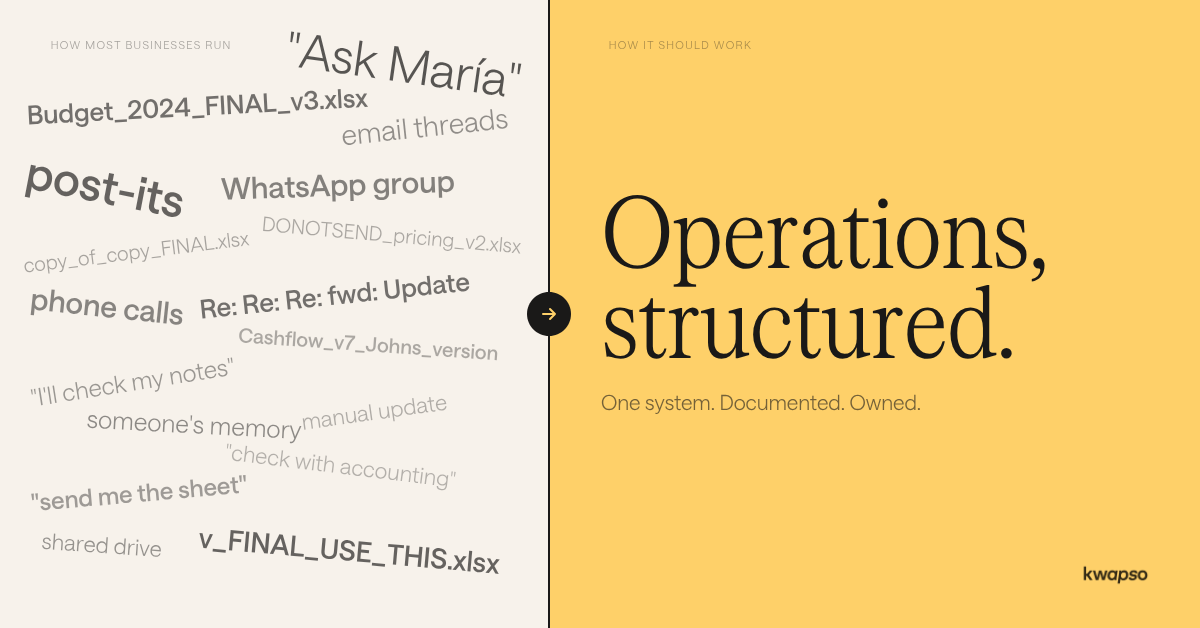
That is not a criticism. It is a pattern we see in every established service business we work with across the DACH region. Construction, insurance, hospitality, staffing, retail. The business works. But it works because of willpower, not because of structure. And willpower has a ceiling.
This guide gives you the same diagnostic we use when we walk into a business for the first time. Thirty questions across six dimensions of operational health. No jargon. No tools to buy. Just an honest mirror.

The businesses that improve fastest are not the ones with the biggest budgets. They are the ones that start by seeing clearly where the cracks are forming.

The Quick Check: Where Do You Stand in Two Minutes?
Before the full assessment, answer six questions. One per dimension. Be honest.
1. Data: If you needed an accurate overview of your current projects right now, how long would it take to assemble? (a) Minutes | (b) Hours | (c) Not sure it is possible
2. Processes: Are your core business processes written down somewhere your team can access? (a) Yes, current | (b) Partially | (c) No
3. People: If your most important person were unavailable for two weeks, what would stop? (a) Nothing critical | (b) Some things | (c) Major functions
4. Communication: Does your team have clear rules for which channel is used for what purpose? (a) Yes | (b) Sort of | (c) No
5. Tools: What percentage of your paid software tools are actually used regularly? (a) Almost all | (b) most of them | (c) Not sure
6. Change: When you last introduced a new tool or process, did the team adopt it? (a) Yes, successfully | (b) Partially | (c) It was abandoned
Mostly (a)? Your foundation is solid. The full assessment below will show you where to optimize.
Mixed? You have strengths to build on and specific gaps to close. The full assessment will tell you which dimension to start with.
Mostly (c)? You are not alone. Most businesses we work with start exactly here. Once you can see it, you can fix it.

We built an interactive version of this assessment that scores you automatically, generates a radar chart of your operational profile, and identifies which of the four patterns your business matches. It takes five minutes. Take the interactive operational health test here
The Full Assessment: Six Dimensions of Operational Health
Data & Information: How organized is your business data?
What this measures. Whether your business information is findable, reliable, and centralized, or scattered across tools, inboxes, and people's heads. This is the foundation dimension. Every dashboard, every report, every AI tool, every automation you will ever want depends on the data underneath being clean and accessible. This also determines whether AI tools will give you reliable answers or expensive guesses.
Why it matters. Research from the University of Hawaii found that 88% of spreadsheets used in professional settings contain errors. MuleSoft's 2025 Connectivity Benchmark Report found that 80% of organizations cite data silos as the single biggest barrier to their automation and AI goals. For a mid-sized service business, this typically means the same client address exists in three different files, nobody knows which version is current, and generating an accurate project overview takes hours instead of seconds. And if you are considering AI tools: this is the dimension that determines whether AI gives you reliable answers or expensive guesses.
The kwapso definition: Single Source of Truth. For every type of information in your business, there is one place where the correct, current version lives. Not three spreadsheets with slightly different numbers. Not an email from last Tuesday. One place. One truth. When that same data needs to appear somewhere else, it flows from the source. It is never manually copied.
Rate yourself:
- When someone needs a client file, project document, or financial record, how quickly can they find the correct, current version? (1 = depends entirely on who you ask | 5 = anyone can find it in under two minutes)
- How much of your core business data exists in more than one place with potentially different versions? (1 = almost everything is duplicated | 5 = every data type has one definitive source)
- If you needed an accurate overview of your current projects, clients, or financial position right now, how long would it take to assemble? (1 = hours of collecting from multiple sources | 5 = I open one dashboard)
- How often do decisions get made based on outdated or incomplete information? (1 = regularly | 5 = almost never)
- Could a new team member find the information they need to do their job without asking colleagues? (1 = impossible without asking | 5 = everything is accessible and organized)
After rating each question from 1 to 5, add up your five answers. A score of 20 or above means this dimension is solid. Between 12 and 19 means there are specific gaps to close. Below 12 means this is a dimension that needs attention before it creates bigger problems.
Scored low here? Read next: Where Does Your Business Data Actually Live? A Self-Audit for CEOs Who Cannot Find the Right File
Processes: Are your processes visible, or do they live in people's habits?
What this measures. Whether the way work gets done in your business is documented, consistent, and traceable, or whether it depends on muscle memory and individual routines.
Why it matters. An invisible process cannot be improved, taught, or automated. It can only be repeated by the person who invented it. When that person is sick, overloaded, or leaves, the process breaks. The DIHK Fachkräftereport 2025/2026 makes the consequence concrete: almost one in four German companies expect to lose company-specific operational knowledge through age-related employee departures. In industry, more than one in three. That knowledge lives in habits, shortcuts, and workarounds, not in systems. And if you are considering AI tools: you cannot automate or teach AI a process that nobody has written down. Invisible processes stay manual, no matter how smart the technology.
The kwapso definition: The Willpower Trap. Your business keeps running not because its systems are good, but because your people push incredibly hard. They compensate for broken processes with effort, long hours, and workarounds. Hard work gets confused with good operations. The business succeeds despite its infrastructure, not because of it.
Rate yourself:
- Are your core business processes (sales, delivery, invoicing, onboarding) written down somewhere that the team can access? (1 = nothing is documented | 5 = all core processes are documented and current)
- If two different team members handle the same process, do they do it the same way? (1 = everyone has their own method | 5 = there is one consistent approach)
- When something goes wrong in a process, can you identify where it broke down? (1 = no visibility into what happened | 5 = every step is traceable)
- How much of your team's time is spent on manual, repetitive steps that follow the same pattern every time? (1 = most of the day | 5 = manual repetition has been largely eliminated)
- When was the last time you reviewed whether your core processes still make sense, or whether they are just "how we have always done it"? (1 = never | 5 = we review processes at least annually)
After rating each question from 1 to 5, add up your five answers. A score of 20 or above means this dimension is solid. Between 12 and 19 means there are specific gaps to close. Below 12 means this is a dimension that needs attention before it creates bigger problems.
Scored low here? Read next: How to Map a Business Process, Even If You Have Never Done It Before and Five Types of Bottlenecks That Are Bleeding Your Business
People & Knowledge: What happens when a key person is unavailable?
What this measures. How concentrated critical knowledge is in specific individuals, and what happens to the business when those individuals are absent, overloaded, or leave.
Why it matters. In Germany, the Institut der deutschen Wirtschaft (IW Köln) projects that around 1.3 million baby boomers reach retirement age every year through 2036, while only 800,000 new entrants join the workforce, a net loss of roughly half a million working-age people per year. By 2036, the German workforce will have shrunk by 4.3 million. In Austria, the joint BMWET–WKÖ Nachfolge-Taskforce reports that 52,500 companies face succession between 2025 and 2034, affecting roughly 705,000 employees; and around half have no successor identified. The knowledge these people carry is not just experience. It is the operational system itself. When it walks out the door undocumented, the business does not just lose an employee. It loses capability. And if you are considering AI tools: this is the knowledge that makes AI useful for your business specifically, not just generic answers anyone could get. Your competitor can use ChatGPT too. AI trained on your company's own structured knowledge is the edge nobody else can copy.
The kwapso definition: Knowledge Silo. Critical operational knowledge (how something is done, where something is stored, why a process works a certain way) lives exclusively inside one person's head. There is no documentation. There is no backup. There is no second person who could step in. Knowledge silos form naturally over years. They are nobody's fault. But they create structural fragility that gets worse with every month they go unaddressed.
Rate yourself:
- If your most important team member were completely unavailable for two weeks (no calls, no emails) what would stop? (1 = critical functions would halt | 5 = everything would continue normally)
- How much of "how things work here" exists only in people's heads rather than in a system or document? (1 = almost everything | 5 = almost nothing, it is all documented)
- Are responsibilities clearly defined, or do people's actual jobs differ significantly from their official role descriptions? (1 = job descriptions bear no resemblance to reality | 5 = roles match reality closely)
- When someone leaves the company, how much operational knowledge leaves with them? (1 = massive loss every time | 5 = minimal disruption, knowledge is in the system)
- Could you hire a replacement for any role and have them productive within a reasonable timeframe based on existing documentation and training materials? (1 = impossible without months of shadowing | 5 = yes, with existing materials)
After rating each question from 1 to 5, add up your five answers. A score of 20 or above means this dimension is solid. Between 12 and 19 means there are specific gaps to close. Below 12 means this is a dimension that needs attention before it creates bigger problems.
Scored low here? Read next: If Your Best Employee Quits Tomorrow, What Breaks? and Is Your Business Ready to Run Without You? The Operational Succession Test
Communication: Does information reach the right people through the right channels?
What this measures. Whether your internal communication is intentional and structured, or whether it leaks, duplicates, and fragments across too many platforms without clear rules.
Why it matters. The average mid-sized business communicates through six or more channels: email, phone, WhatsApp, a team chat tool, in-person conversations, meetings, and sometimes sticky notes. Each channel was added to solve a problem. None were designed to work together. The result: a decision made in a meeting gets communicated by email, questioned on WhatsApp, clarified by phone, and then nobody remembers which version is the final one. Information does not get lost because people are careless. It gets lost because there are too many places for it to live. And if you are considering AI tools: an AI assistant that answers team questions is only useful if decisions and information are stored somewhere structured. If they live in WhatsApp threads, no AI can find them.
Rate yourself:
- Does your team have a clear, agreed-upon system for which communication channel is used for what? (1 = no, everything goes everywhere | 5 = yes, each channel has one defined job)
- When a decision is made, does everyone who needs to know about it actually find out? (1 = things fall through the cracks regularly | 5 = decisions reliably reach the right people)
- How often does someone ask "did you see my message?" because information got buried in the wrong channel? (1 = daily | 5 = almost never)
- Do your meetings have clear agendas, defined outcomes, and documented action items? (1 = meetings are mostly unstructured | 5 = every meeting follows a clear format)
- How many different channels does your team use to communicate internally, and does each one have a defined purpose? (1 = six or more channels with no clear rules | 5 = two to three channels, each with a defined purpose)
After rating each question from 1 to 5, add up your five answers. A score of 20 or above means this dimension is solid. Between 12 and 19 means there are specific gaps to close. Below 12 means this is a dimension that needs attention before it creates bigger problems.
Scored low here? Read next: Your Company Communicates Through Seven Channels. That Is Six Too Many.
Tools & Systems: Are your tools connected, or are they disconnected islands?
What this measures. Whether your software tools work together as a system, or whether they are standalone purchases that create more work than they save.
Why it matters. MuleSoft's 2025 Connectivity Benchmark Report found that organizations average 897 applications, but only 29% are integrated. For a mid-sized business, the number is smaller, but the pattern is the same: tools bought at different times, for different problems, by different people, never connected to each other. Data gets entered in one system and re-entered by hand in another. Reports require pulling numbers from four platforms and reconciling them in Excel. The tools were supposed to save time. Instead they created new silos. And if you are considering AI tools: AI needs connected systems to pull data from. Disconnected tools mean disconnected answers.
Rate yourself:
- How many software tools does your company currently pay for? Do you know the exact number? (1 = no idea | 5 = I know every tool, what it costs, and who uses it)
- What percentage of those tools are actually used regularly by the team they are intended for? (1 = less than half | 5 = all of them, by the right people)
- When data is entered into one tool, does it automatically appear where else it is needed, or does someone re-enter it manually? (1 = almost everything is re-entered | 5 = data flows automatically between systems)
- Could you describe in one sentence what each tool in your stack does and why you chose it? (1 = several tools overlap or have no clear purpose | 5 = every tool has one clear job)
- If you stopped paying for a tool tomorrow, would anyone notice within the first week? (1 = probably not, for several | 5 = yes, for all of them)
After rating each question from 1 to 5, add up your five answers. A score of 20 or above means this dimension is solid. Between 12 and 19 means there are specific gaps to close. Below 12 means this is a dimension that needs attention before it creates bigger problems.
Scored low here? Read next: You Do Not Have a Tool Problem. You Have a Process Problem.
Readiness to Change: Can your business actually adopt new ways of working?
What this measures. Whether your business and team can realistically implement changes, or whether past failures, workload, and culture make every improvement feel impossible before it starts.
Why it matters. McKinsey's research on transformations finds that roughly 70% of organizational change initiatives fail. This happens not because the idea was wrong, but because the rollout was. A business might have chaotic operations and a willing, energized team. Or it might have decent systems and a team that resists every change because the last three software rollouts were abandoned within a month. The first scenario is solvable. The second is much harder. And if you are considering AI tools: AI is a change project. If your team has not successfully adopted simpler tools, an AI rollout will face the same wall.
Rate yourself:
- When your company has introduced a new tool or process in the past, how well did the team adopt it? (1 = most changes are abandoned within weeks | 5 = changes are adopted successfully with proper support)
- Does your team have the capacity (in time and energy) to learn and implement new approaches right now? (1 = everyone is already overwhelmed | 5 = there is bandwidth for improvement)
- How would you describe your team's general attitude toward change? (1 = resistant, "we have always done it this way" | 5 = open, if the reason is clear and the support is there)
- When something is not working, does the team flag it openly, or do they work around it quietly? (1 = workarounds are the norm, nobody speaks up | 5 = problems are raised and addressed quickly)
- Do you have someone in the organization who could lead or champion an operational improvement project? (1 = nobody, and I do not have time either | 5 = yes, and they would be motivated to do it)
After rating each question from 1 to 5, add up your five answers. A score of 20 or above means this dimension is solid. Between 12 and 19 means there are specific gaps to close. Below 12 means this is a dimension that needs attention before it creates bigger problems.
Scored low here? Read next: Eliminate, Streamline, Then Automate: Why the Order Matters and 95% of AI Projects Deliver Zero ROI. Here's Why, and What to Fix First.

Reading Your Shape: What Does Your Operational Profile Tell You?
Now look at your six scores side by side. The total matters less than the shape. A business with consistent 3s across all dimensions is often in a stronger position than one with two 5s and four 1s. Consistency means the foundation is even. Spikes and dips mean certain areas are compensating for others, and that compensation has a daily cost in time, money, and nerves.
Four common profiles
After running this diagnostic with dozens of businesses, the same patterns keep appearing.
1. The Founder's Grip. High on tools and processes, low on people & knowledge and readiness to change. The CEO has built systems, but they all run through him. The business works because he works. Nobody else can step in. Classic willpower trap.
2. The Invisible Machine. The business performs well but scores low across data, processes, and communication. It runs on good people and established habits. Nothing is documented. Nothing is visible. It works until someone leaves or the business needs to grow.
3. The Tool Graveyard. Low on tools & systems, high on people & knowledge. The team is strong, but doing everything manually because past technology investments failed. Good people are being wasted on mechanical work.
4. Ready But Stuck. High on readiness to change, low on data and processes. The team wants to improve, but there is no foundation to improve from. This is the most encouraging profile. The hardest part (willingness) is already solved.
What to do with your results
Start with your weakest dimension. Not all of them at once. Pick the one where the gap is largest and the daily frustration is highest.
If your weakest areas are Data or Processes, that is actually good news. Those are the foundational dimensions. Fixing them tends to improve everything downstream.
If People & Knowledge is your weakest, that is the most urgent. Knowledge silos are a structural vulnerability that gets worse with time, not better.
For each dimension, we have published a dedicated guide that goes deeper. The links above each section's score point you to the right next step based on your specific results.

82% of DACH mid-sized companies still operate with predominantly manual or semi-automated processes. Source: Digitalisierungsstudie 2024/2025.
Where does AI fit?
You may be wondering where AI fits in all of this. The short answer: your operational health score is your AI readiness score. Every dimension you just rated, from data quality to process documentation to knowledge concentration, is a prerequisite for AI to deliver real value. AI built on messy data gives messy answers. AI applied to undocumented processes automates the wrong things. AI without structured domain knowledge produces generic output your competitor can get too. We cover this in full in 95% of AI Projects Deliver Zero ROI. Here's Why, and What to Fix First. For now, the takeaway is simple: fix the foundation first. AI will be waiting.
Your Next Step
The shape of your operational health matters more than any individual score. A business with an even foundation can build forward. A business with deep gaps will keep tripping over the same problems, no matter what tools it buys.
You now have the same lens we use when we sit down with a business for the first time. The six dimensions. The questions. The patterns.
That said, we also know what happens after the assessment. You see the gaps. You know what needs to change. And then Monday arrives. The phone rings. The inbox overflows. Finding the time to map your processes, clean up your data, restructure your communication, and connect your tools, on top of running the business, is not realistic for most CEOs.
If you see the value in this approach but do not have the bandwidth to implement it yourself, here is what working with us looks like: a senior operational engineer dedicated to your business, a structured audit deeper than any self-assessment, a clear roadmap of what to fix and in what order, and sprint-based delivery with real progress every few weeks. We stay after the build.
If two or more of your dimensions came in below 15, the gaps are compounding daily, and a self-assessment is the first step, not the last one.
Ready to see how your operations look under structure? Book a structured operations call here.
Whether you take this on yourself or hand it to us, we hope this assessment gives you a clearer view of where the cracks are, and where the foundation is already strong.
FAQ
How do I know if my business operations are healthy?
Operational health has six measurable dimensions: data organization, process documentation, knowledge concentration, communication structure, tool integration, and change readiness. A business with consistent scores across all six is structurally sound. One with deep gaps, even if profitable, is running on willpower, not systems. 82% of DACH mid-sized companies still operate with predominantly manual or semi-automated processes (Digitalisierungsstudie 2024/2025).
What is the Willpower Trap in business?
The Willpower Trap describes a business that succeeds not because its systems are good, but because its people push hard enough to compensate for broken processes. Long hours and workarounds get confused with good operations. The business works, until someone quits, gets sick, or the company needs to grow. It is the most common operational pattern in established service businesses with 20–250 employees.
What is a Single Source of Truth in operations?
A Single Source of Truth means every type of business information: clients, projects, invoices, suppliers: has one definitive location where the correct, current version lives. When that data needs to appear elsewhere, it flows automatically from the source. It is never manually re-entered or copy-pasted. Research from the University of Hawaii found that 88% of professional spreadsheets contain errors; duplicate data systems compound that risk across the entire business.
How do I prioritize which operational problems to fix first?
Start with your weakest dimension, not the easiest one. If Data or Processes is weakest, begin there: they are foundational, and fixing them tends to improve everything downstream. If People & Knowledge is weakest, treat it as urgent. Knowledge silos get worse every month they go unaddressed, and a single resignation can cost a year of recovery.


