You have seen this movie before. A vendor demo that looked perfect. A team meeting where everyone agreed "this is exactly what we need." A purchase decision, an onboarding call, maybe even a few weeks of genuine effort. And then, slowly, the team drifts back to Excel. Back to WhatsApp. Back to the way things were before.
Six months later, the tool sits unused. The subscription renews automatically. Nobody cancels it because nobody wants to admit it failed. And the next time someone suggests a new tool, the room goes quiet.
This is not a technology problem. It is not a training problem. It is not even a people problem. It is a process problem. And until you fix the process, every tool you buy will follow the same arc: excitement, effort, abandonment.
Research shows that nearly 50% of SaaS licenses go unused within 90 days. Flexera's 2025 State of ITAM Report estimates that 25 to 30% of IT budgets are wasted on redundant tools, unused licenses, and poor visibility. And BetterCloud's 2025 State of SaaS Report found that 63% of organizations cite unused or underutilized applications as a primary driver of SaaS consolidation.
The problem is not that businesses buy the wrong tools. The problem is that they buy tools to solve problems that are not tool-shaped.

The tool is not the problem. The missing process is the problem. A tool can only make a structured workflow faster. It cannot create structure where none exists.

Why does buying the right tool still fail?
Most tool purchases follow the same pattern. A CEO or manager feels a pain. Maybe the team is losing track of tasks. Maybe client data is scattered. Maybe invoicing takes too long. The instinct is natural: find a tool that fixes it.
But here is what usually happens next. The tool is evaluated based on its features, not based on the process it needs to support. Nobody maps how the work currently flows. Nobody documents who does what, in what order, with what information. Nobody identifies where the actual friction lives. The tool gets chosen because its demo looked clean, not because it fits how the business actually operates.
Then the tool meets reality. And reality is messy. The team discovers that the tool expects data in a format they do not have. Or that the workflow in the tool assumes three steps, but their real process has seven. Or that the tool solves the visible symptom (task tracking) but not the underlying cause (nobody knows who is responsible for what).
The tool is not the problem. The missing process is the problem. A tool can only make a structured workflow faster. It cannot create structure where none exists.
The kwapso definition: the tool is never the solution. The tool is the last step. Before choosing any tool, you need three things: a mapped process (what actually happens, step by step), a clear owner (who is responsible for what), and clean data (the information the tool needs to work with). Without these three, the best tool in the world will become shelfware within a quarter.
Already bought tools that sit unused? Read next: What Is Your Business Actually Costing You? How to Calculate the Hidden Price of Manual Operations to see what that unused software is really costing alongside your manual processes.
What is the willpower trap, and why does it keep your business stuck?
There is a deeper pattern beneath the tool failures. We call it the Willpower Trap.
The kwapso definition: The Willpower Trap. Your business keeps running not because its operational systems are good, but because your people push incredibly hard. They compensate for broken processes with effort, long hours, and workarounds. The CEO answers WhatsApp at 11pm. The office manager re-enters the same data into three systems because "that is how we do it." The project lead keeps the whole project status in her head because there is no system to put it in. The business succeeds despite its infrastructure, not because of it.
The trap is that it works. For years, even decades, willpower carries the business. So nobody questions it. Hard work gets confused with good operations. The exhaustion feels like virtue.
Until it does not work anymore. Until the CEO gets sick. Until the office manager quits and nobody knows how invoicing actually works. Until the business needs to grow and there is no way to replicate what lives in one person's head. Until a competitor with better systems delivers the same service faster, cheaper, and more consistently.
The 2024/2025 Digitalisierungsstudie for DACH mid-sized companies found that 82% still operate with predominantly manual or semi-automated processes, and 64% struggle with process analysis and documentation. These businesses are not failing. They are succeeding through willpower, and that willpower has a ceiling.
The tool trap and the willpower trap feed each other. The CEO feels the operational pain. He buys a tool. The tool fails because the processes underneath are invisible. He concludes "tools do not work for us." He goes back to willpower. The cycle repeats.
Breaking the cycle requires a different starting point. Not "which tool should we buy?" but "what is actually happening in our operations, and where is the friction?"
Want to see where your willpower is compensating for missing structure? Take the 30-Question Operational Health Check and look at your People & Knowledge and Processes scores.
What are the four traps that keep businesses buying instead of fixing?
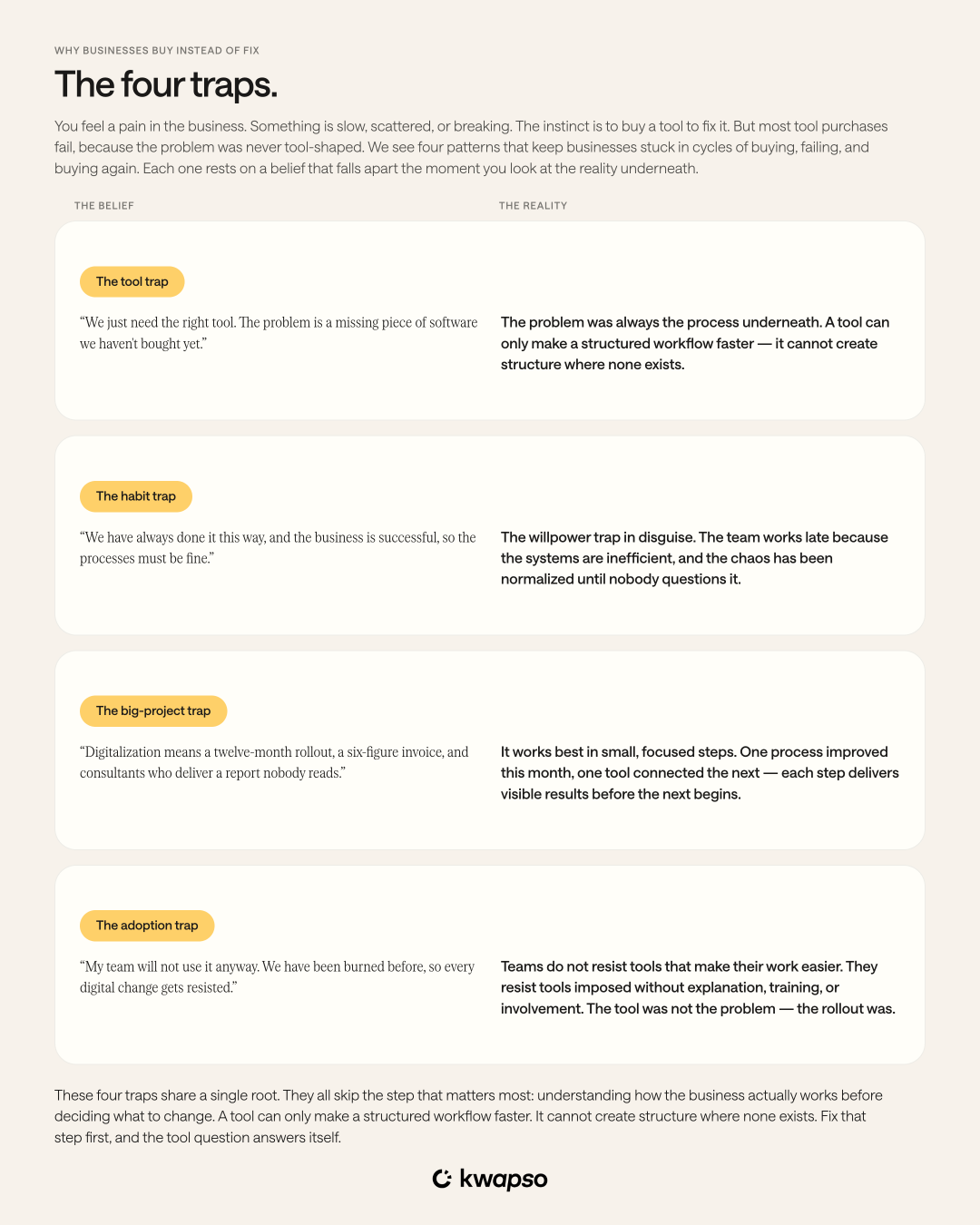
The tool trap is the most common, but it is not the only one. We see four patterns that keep businesses stuck in cycles of buying, failing, and buying again.
Trap 1: "We just need the right tool."
The belief that the problem is a missing piece of software. So you compare forty tools, buy one, nobody uses it, and you are back to Excel within a month. The real issue was never the tool. It was the process underneath. A tool cannot fix a broken workflow. It can only make a structured workflow faster.
Trap 2: "We have always done it this way."
The assumption that because the business is successful, the processes must be fine. This is the willpower trap in disguise. The team works late not because the work demands it, but because the systems are inefficient. The chaos has been normalized. Nobody questions it because "it works."
Trap 3: "Digitalization is a big project with a big price tag."
You imagine a twelve-month IT rollout, a six-figure invoice, and a team of consultants who deliver a report nobody reads. So you postpone. Or you try to do everything at once and burn out. The reality: operational improvement works best in small, focused steps. One process improved this month. One tool connected next month. Each step delivers visible results before the next one begins.
Trap 4: "My team will not use it anyway."
You have been burned before. Bought software, rolled it out, and watched the team go back to WhatsApp within two weeks. Now you assume every digital change will be resisted. But teams do not resist tools that make their work easier. They resist tools that are imposed without explanation, without training, and without involvement. The tool was not the problem. The rollout was.
These four traps share a common root: they all skip the step that matters most. Understanding how the business actually operates before deciding what to change.
What does it actually look like when the process comes first?
Here is the difference in practice.
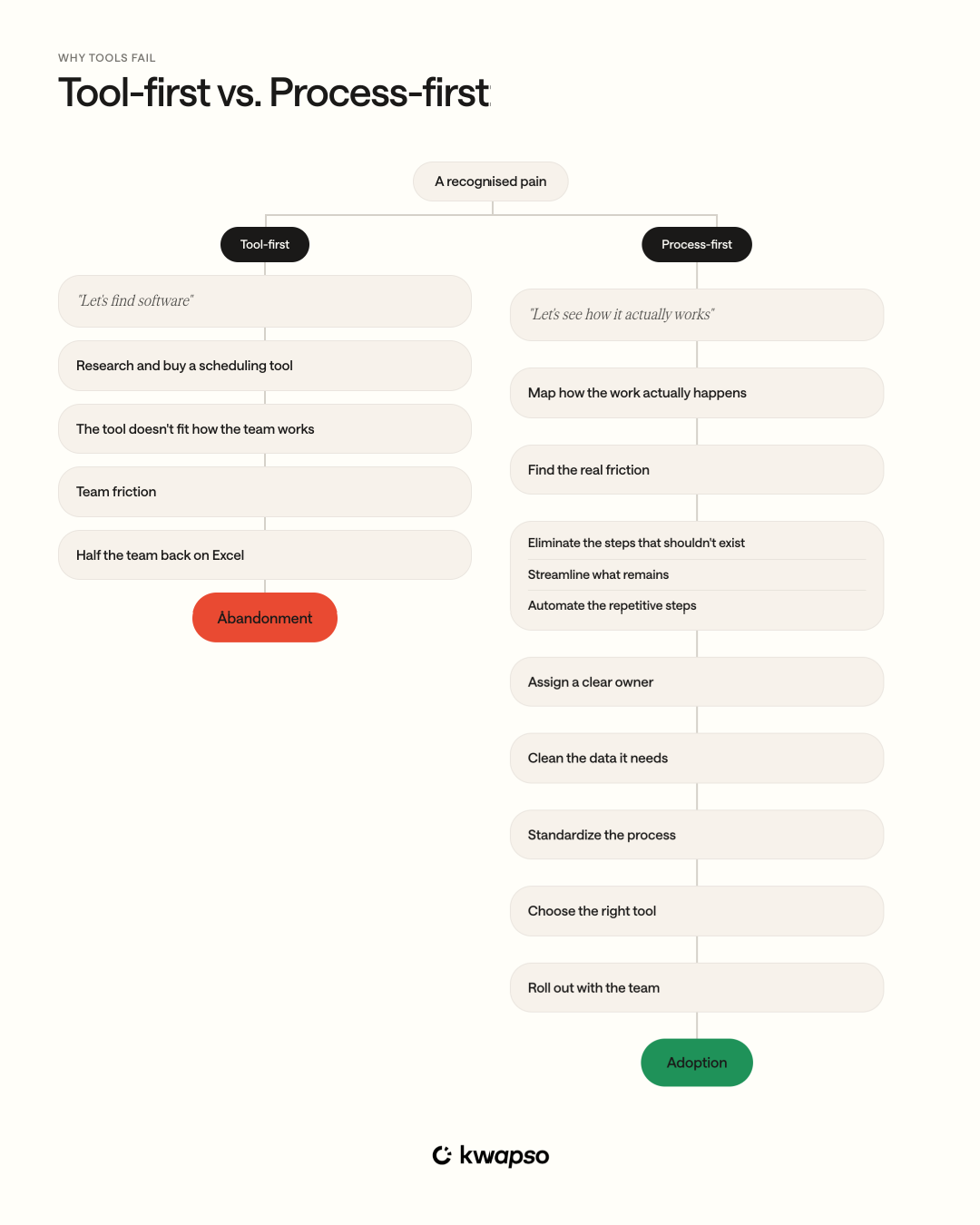
The tool-first approach. A hospitality group with four locations decides their scheduling is a mess. They research scheduling software, pick one, roll it out to all four location managers. Within a month, two managers are using it, one is using it partially, and one has gone back to Excel because the tool does not handle the way she splits shifts. Six months later, the company is paying for the tool but half the scheduling still happens in spreadsheets and WhatsApp.
The process-first approach. The same hospitality group starts by mapping how scheduling actually works at each location. They discover that the four managers do it in four different ways. One uses time blocks, another uses a rotation system, two do it ad hoc based on who is available. They also discover that 40% of the weekly scheduling time is spent handling last-minute changes via WhatsApp, not building the initial schedule.
Tool-first approach vs. Process-first approach
Starting point
Tool-first: “Our scheduling is a mess. Let’s find software.”
Process-first: “Our scheduling is a mess. Let’s see how it actually works.”
First action
Tool-first: Research and buy a scheduling tool
Process-first: Map how scheduling works at each location
What they discover
Tool-first: The tool doesn’t fit how the team works
Process-first: Four managers do it four different ways; 40% of time goes to WhatsApp changes
Result at 6 months
Tool-first: Half the team is back on Excel. Tool subscription renews unused.
Process-first: Standardized process, targeted tool selection, high adoption
With the process mapped, the priorities become clear. First: standardize the scheduling method across locations. Second: create a simple change-request process that replaces WhatsApp. Third: choose a tool that supports the standardized process. The tool selection takes half the time it would have taken before, because the requirements are specific and clear. The adoption rate is higher because the tool fits how the team now works, not how a vendor imagined they might work.
The difference is not the tool. The difference is the order.

80% of AI projects fail — twice the rate of non-AI IT projects (RAND Corporation, 2024). In 2025, 42% of companies scrapped most of their AI initiatives, up from 17% the year before (S&P Global Market Intelligence). The pattern is identical to the SaaS graveyard: excitement, purchase, reality, abandonment.
AI is the newest version of the tool trap
One more trap worth naming, because it is the one most businesses are walking into right now.
A CEO hears about AI constantly. He knows his competitors are "using AI." He feels the pressure to act. So he buys an AI tool, plugs it into his business, and discovers that it produces unreliable results, hallucinates data, or simply does not understand how his company operates.
The reason is the same as every other tool failure: the foundation is missing. AI needs clean, structured data to work with. It needs documented processes to learn from. It needs organized information to retrieve. Without those, AI is not intelligent. It is confidently wrong.
RAND Corporation's 2024 report found that more than 80% of AI projects fail, twice the rate of non-AI IT projects. S&P Global Market Intelligence's 2025 AI Experience Survey found that 42% of companies scrapped most of their AI initiatives in 2025, up from 17% the year before. The pattern is identical to the SaaS graveyard: excitement, purchase, reality, abandonment.
The fix is also identical: process first, data second, tool third. AI is not the exception to this rule. It is the most expensive proof of it.
For the complete picture on why AI fails without operational foundations: 95% of AI Projects Deliver Zero ROI. Here's Why, and What to Fix First.
What should I check before buying business software?
If you are considering any tool, software, or AI investment, run through these five questions first. If you cannot answer all five clearly, the purchase is premature.
- What process will this tool support? Can you describe it step by step? Is it written down? If not, map it first. A tool without a mapped process is a solution looking for a problem.
- What data does this tool need to work with? Is that data clean, current, and in one place? If the same data exists in three spreadsheets with different versions, the tool will inherit the confusion.
- Who is responsible for using this tool daily? Not "the team." A specific person with a specific role. If nobody owns it, nobody will maintain it.
- What does success look like in 90 days? Not "we are using the tool." A measurable outcome: "client onboarding takes 20 minutes instead of 55" or "project status is visible without a phone call." If you cannot define the outcome, you cannot evaluate whether the investment worked.
- What happens to the team's current workflow? Will they stop doing something they currently do? If the new tool adds work on top of existing work without removing anything, adoption will fail. People do not adopt tools that add to their load. They adopt tools that replace something harder with something easier.
These five questions cost nothing and take thirty minutes. They will save you more than any vendor demo ever could.
Ready to map the process that keeps causing friction? Read next: How to Map a Business Process, Even If You Have Never Done It Before
Want to identify where the friction actually lives within your processes? Read next: Five Types of Bottlenecks That Are Bleeding Your Business, and How to Spot Them
Your Next Step
The tool is never the starting point. The process is. Every successful technology investment we have seen, across 15+ industries and 150+ operational conversations, started with the same foundation. A mapped process, clean data, and a clear owner. The businesses that skipped this step paid twice: once for the tool, and once for the time wasted trying to make it work.
You now have the framework to break the cycle. The four traps. The five pre-purchase questions. The process-first sequence.
Mapping processes, cleaning data, and redesigning workflows takes time and expertise that most CEOs do not have sitting idle. The day-to-day business demands every hour you have. If you want that groundwork done properly before your next technology decision, we start with a structured process audit and turn it into a roadmap of what to fix, in what order, before any tool gets chosen. Sprint-based delivery. We stay after the build.
Ready to stop buying tools and start building structure? Book a structured operations call here.
Whether you take this on yourself or hand it to us, we hope this guide changes the question from “what tool should we buy?” to “what process should we fix?”
FAQ
Why does business software go unused after purchase?
Nearly 50% of SaaS licenses go unused within 90 days. The most common cause is not the software itself but the missing foundation: the process the tool was supposed to support was never mapped, the data it needed was not clean, or nobody was assigned to own and maintain it. A tool that meets an undocumented process meets chaos, and chaos wins.
What should a business check before buying any software?
Five prerequisites determine whether a tool will succeed: a mapped process (step-by-step documentation of how the work flows), clean data (the information the tool needs, in one place, in the right format), a clear owner (one person responsible for adoption), a defined 90-day success metric, and workflow replacement (the tool must remove existing work, not add on top of it).
What is the difference between a tool problem and a process problem?
A tool problem means the workflow is solid but the technology supporting it is inadequate. A process problem means the underlying workflow is invisible, inconsistent, or broken; and no software can fix that. In practice, most failed tool investments trace back to missing process documentation, not wrong software selection. 25–30% of IT budgets are wasted on redundant tools and unused licenses (Flexera).
Why do AI implementations fail in mid-sized businesses?
AI fails for the same reason other business software fails: the foundation is missing. AI requires structured data to learn from, documented processes to optimize, and clean information to retrieve. 80% of AI project failures trace back to organizational readiness, not technology limitations. AI built on messy data produces confident but wrong answers.


