You know the feeling. You walk through the office on a Tuesday morning, and half your team is doing work that should not need a human. Copying numbers from one spreadsheet to another. Chasing a colleague for a status update they should have sent three days ago. Re-entering the same client data into a second system because the first one does not talk to the other. Typing an email you have typed forty times before, changing only the name and the date.
Nobody complains, because it has always been this way. And the work gets done. But here is the question nobody asks: what does all of this actually cost?
Not in the abstract. In euros. Per year. Across your whole team.
When we sit down with a business for the first time, this is one of the earliest exercises we do. We take the manual processes the team does every day, put numbers on them, and add them up. The reaction is almost always the same. Not shock at any single task. Shock at the total.
A global study by Automation Anywhere surveyed over 10,000 office workers and found that the average employee spends more than three hours per day on manual, repetitive tasks that are not part of their primary job. Formstack's research puts it more bluntly: 55% of managers lose a full workday every week to repetitive manual work. And the 2024/2025 Digitalisierungsstudie for the DACH region found that 82% of mid-sized companies still operate with predominantly manual or semi-automated processes.

These are not broken businesses. These are successful businesses bleeding money in places nobody has measured.

This guide gives you the formula, three worked examples, and a simple exercise to calculate your own number. You will not need any tools. A pen, a calculator, and an honest afternoon will do.
How do you calculate the cost of a manual process?
The math is simple. What makes it powerful is applying it to enough tasks that the total becomes impossible to ignore.
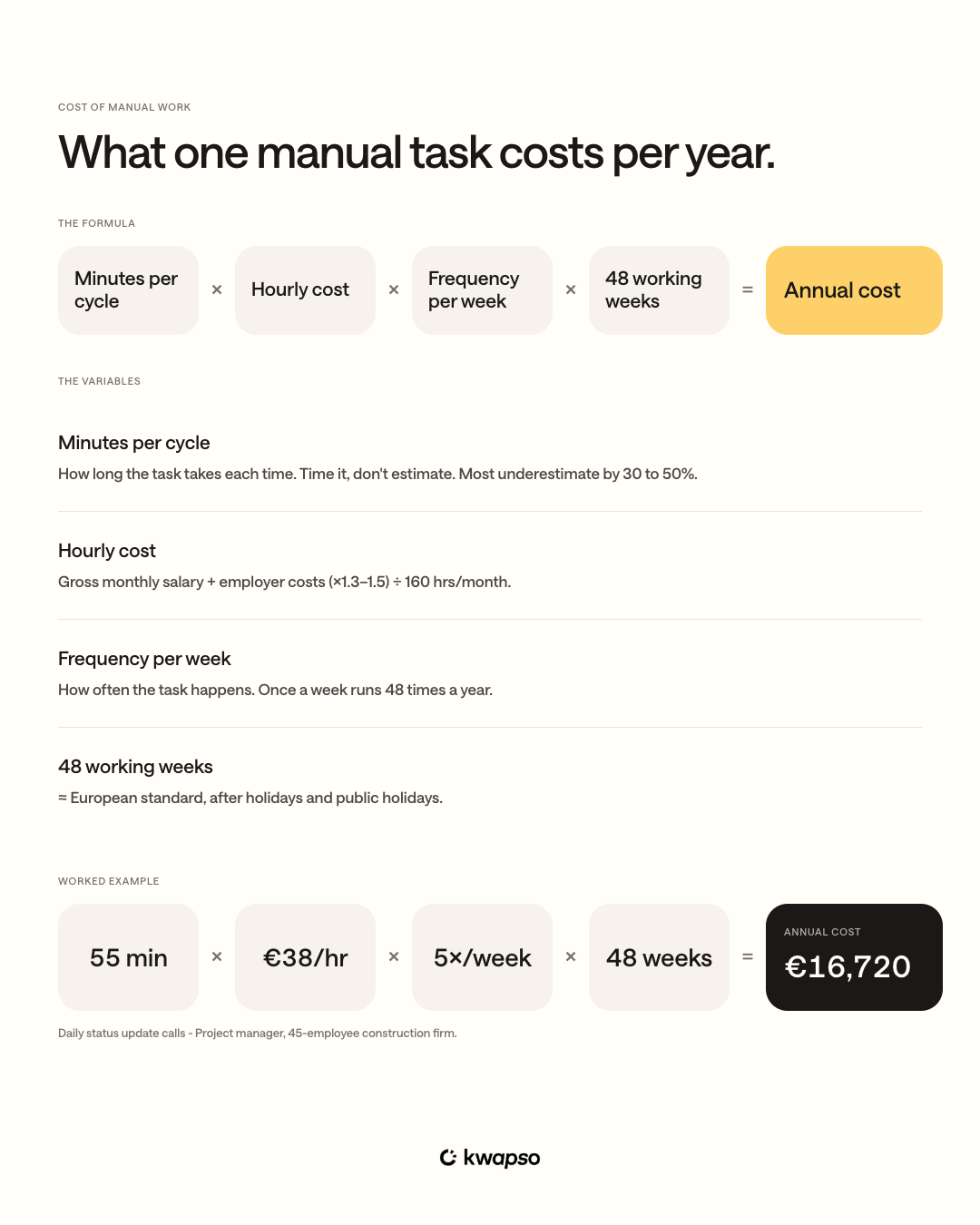
Annual cost = (Minutes per cycle ÷ 60) × Hourly cost of the person × Frequency per week × 48 working weeks
That is four variables:
Minutes per cycle. How long the task takes each time it is done. Be specific. Not "about half an hour." Time it. Most people underestimate this by 30 to 50%, because they forget the setup time, the searching, the interruptions, and the follow-up.
Hourly cost. Not just the salary. Include employer costs: social contributions, insurance, overhead. A rough rule for DACH businesses: multiply the gross monthly salary by 1,3 to 1,5, then divide by 160 working hours per month. An employee earning 3.500 € gross per month costs the business roughly 28 € to 33 € per hour.
Frequency per week. How often the task happens. Daily tasks multiply fast. A task done five times per week, fifty weeks per year, runs 250 times. A task done once a week runs 48 times.
48 working weeks. Standard for DACH after holidays and public holidays.
Here is the critical insight: no single task looks expensive. Twenty minutes here, fifteen minutes there. But when you map fifteen or twenty of these across your team, the total becomes a number that changes the conversation.
Three Examples from Real Industries
These are composites drawn from businesses we have worked with. The details are changed, but the patterns are real.
Example 1: The construction company that lost €38,000 to status updates
A construction firm with 45 employees. The project manager spent 25 minutes every morning calling three site supervisors for status updates, then another 20 minutes entering the information into a shared spreadsheet, then another 10 minutes writing a summary email to the CEO.
One task. 55 minutes per day. Done by someone who costs the business €38/hour.
(55 ÷ 60) × 38 € × 5 × 48 = 16.720 € per year. For one person, on one task.
But the site supervisors also spent 10 minutes each on those calls. Three people, five days a week, at €30/hour.
(10 ÷ 60) × 30 € × 5 × 48 × 3 = 3.600 € per year.
And the CEO spent 15 minutes reading and digesting the summary email every morning. At €55/hour.
(15 ÷ 60) × 55 € × 5 × 48 = 6.600 € per year.
One process. Five people. No value created. No decision improved. Just information moving from heads to phones to spreadsheets to email.
Total: 26.920 € per year. And we have not even counted the delays when a supervisor does not pick up the phone, or the errors when numbers are transcribed wrong.
When this company replaced the process with a shared project dashboard that site supervisors updated directly from their phones, the daily status call disappeared. The 55-minute morning routine became a 5-minute dashboard check. The annual saving was not theoretical. It showed up in the project manager's calendar as recovered hours, every single week.
Example 2: The insurance broker who typed the same data seven times
An insurance brokerage with 30 employees. When a new client signed up, the onboarding process required entering the client's basic information (name, address, policy details, contact info) into seven different places: the CRM, the email system, the policy management tool, a shared Excel tracker, a physical folder, the accounting system, and a client welcome email template.
Each entry took about 8 minutes. Seven entries per new client: 56 minutes total. The team onboarded roughly 12 new clients per week. The person doing the work cost €32/hour.
(56 ÷ 60) × 32 € × 12 × 48 = 17.203 € per year.
But the real cost was not just the typing. It was the errors. When the same data is entered manually seven times, at least one of those entries will be wrong. An incorrect address on the policy document. A misspelled name in the welcome email. A wrong phone number in the CRM. Each error triggered a correction cycle: someone notices, someone investigates, someone fixes it, someone apologizes. Average correction time: 20 minutes per error, happening roughly 8 times per week.
(20 ÷ 60) × 32 € × 8 × 48 = 4.096 € per year in rework alone.
Total: 21.299 € per year. For one process. One role. One type of data.
Example 3: The hospitality group that scheduled by WhatsApp
A hospitality group running four locations with 120 employees. Staff scheduling was done weekly by four location managers, each spending roughly 90 minutes building the schedule in Excel, then another 30 minutes communicating it via WhatsApp, then another 45 minutes throughout the week handling swap requests, sick calls, and changes, all through WhatsApp messages that had to be manually updated in the Excel file.
Total weekly time per manager: 165 minutes. Four managers, at €35/hour.
(165 ÷ 60) × 35 € × 4 × 48 = 18.480 € per year.
But the hidden cost was the cascading disruption. When a swap request came in via WhatsApp at 10pm, the manager either responded immediately (losing personal time) or responded in the morning (leaving the shift uncovered for hours). On average, two shifts per week across all locations had coverage problems that took 30 minutes each to resolve, involving the manager and at least one other person.
(30 ÷ 60) × 35 € × 2 × 48 = 1.680 € per year in fire-fighting. Plus the unmeasured cost: staff frustration, client experience on understaffed shifts, and a manager who checks WhatsApp at midnight because the system demands it.
Total visible cost: 20.160 € per year. Total real cost is higher.

Cost of Chaos Calculator
A free spreadsheet that calculates your annual manual work cost automatically. Enter your tasks, hourly costs, and frequencies: it returns weekly and annual cost per process, applies the hidden cost multiplier, and gives you a visual breakdown of where the money goes.
Thank you! Your submission has been received!
Oops! Something went wrong while submitting the form.
Thank you. Your download should start automatically.
Oops! Something went wrong while submitting the form.
What Nobody Counts: The Hidden Multiplier
The examples above capture direct labor cost. But that is only the visible portion. For every euro spent on direct labor for manual processes, businesses incur substantial additional costs that almost never appear on any timesheet or budget line. Across our client work, the indirect costs of manual operation consistently dwarf the direct labor cost. They include:
Error correction. Manual work produces errors. Errors produce rework. Rework produces delays. Delays produce client dissatisfaction. The cascade is predictable and expensive.
Context switching. Every time someone stops their real work to do a manual task, it takes an average of 8 minutes to get back to focused work afterward. Fifteen interruptions per day is two hours of lost focus, invisible on any timesheet.
Opportunity cost. The hours your team spends on manual work are hours they do not spend on the work that grows the business. Your best project manager is not managing projects. She is copying data. Your sales lead is not building relationships. He is chasing internal updates.

41% of workers consider leaving specifically because of repetitive manual tasks. Replacing a mid-level employee costs 50 to 150% of their annual salary. One preventable resignation pays for a significant operational improvement project.
The Exercise: Calculate Your Own Number
Take your top ten manual processes. You identified some of them if you worked through the self-assessment in Guide 1. If not, think about the tasks your team does every day that follow the same pattern, involve the same steps, and produce no new thinking. Data entry. Status chasing. Report assembly. File searching. Manual scheduling. Copy-pasting between tools.
For each one, fill in the formula:
- Process or task
Daily status update calls - Who does it
Project manager - Minutes per cycle
55 - Hourly cost (€)
88 - Times per week
5 - Weekly cost (€)
(55 ÷ 60) × 88 € × 5 = 403 € - Annual cost (€)
403 € × 48 = 19.344 €
List your top ten manual processes and run each one through the same format. For each process, note who does it, how many minutes it takes per cycle, their hourly cost, and how many times per week it happens. Then calculate the weekly and annual cost for each. Use a piece of paper, a spreadsheet, or download our free Cost of Chaos Calculator to do it automatically.
Sit with this number for a moment.
Across our client base, the average is 40.000 € to 80.000 € per year in direct labor cost for processes that could be structured, streamlined, or automated. For larger teams, it regularly exceeds 100.000 €. And that is before the hidden multiplier.
This number is not about blame. Every business has manual processes. The question is whether you know what they cost, and whether you are spending that money on purpose or by accident.
.png)
What Your Number Tells You
The absolute number matters less than what it represents as a share of your operations. A 30.000 € annual cost in a business with 1,5 M € revenue and 15 employees is a very different problem than 30.000 € in a business with 20 M € revenue and 150 employees. The right way to read your result is as a percentage of your total payroll cost.
Take your total from the exercise. Divide it by your annual payroll cost (all salaries plus employer contributions). Multiply by 100.
Under 3% of payroll: Your operations are relatively lean. There is always room to improve, but you are not bleeding. Focus on the one or two highest-cost processes and optimize those.
3% to 8% of payroll: This is where most businesses land. It means that for every €100 you spend on your team, €3 to €8 goes to work that creates no value. That is significant enough to justify a focused improvement project, and small enough that the right changes can pay for themselves within months.
Over 8% of payroll: This is a structural problem, not a collection of small inefficiencies. You are spending a meaningful share of your people budget on work that should not exist. At this level, the cost competes with one or two full-time salaries. The business is essentially paying invisible employees to move data, chase updates, and correct errors.
Regardless of your percentage, the next step is the same: identify the three processes with the highest annual cost, and fix those first. Not all ten. Not a complete overhaul. Three processes, improved or eliminated, can recover 60 to 70% of the total. That is the principle behind the kwapso roadmap: Map it, Measure it, Simplify it, Build it, Scale it. You have just completed the first two steps.
Want to go deeper on finding the specific friction points within each process? Read next: Five Types of Bottlenecks That Are Bleeding Your Business, and How to Spot Them
Ready to map those top three processes step by step? Read next: How to Map a Business Process, Even If You Have Never Done It Before
Want to understand the right order for fixing them? Read next: Eliminate, Streamline, Then Automate: Why the Order Matters
Before You Invest in AI, Know This Number
One more thing. If you are considering AI tools, automation platforms, or any technology investment to "save time" or "increase efficiency," this number is where the conversation should start.
Most businesses skip this step. They hear about AI, get excited, buy a tool, and discover it saves fifteen minutes on a task that costs €800 per year. Meanwhile, there is a €22,000 manual process sitting right next to it that nobody has measured.
Calculate first. Then invest. The biggest savings almost always come from eliminating and restructuring work, not from adding technology on top of it. AI amplifies whatever is underneath. If the underneath is structured, AI amplifies efficiency. If the underneath is chaos, AI amplifies chaos.
For the full picture on this: 95% of AI Projects Deliver Zero ROI. Here's Why, and What to Fix First.
Your Next Step
Manual work has a price, and the price is almost always higher than anyone expects. Not because anyone is doing something wrong, but because the cost is invisible until you measure it.
You now have the formula, the examples, and the exercise. You can calculate your own number this afternoon.
Finding the manual processes is the easy part. Fixing them, restructuring the workflows, connecting the tools, training the team, and making the change stick, that is the work that takes months, not hours. And it is not work most CEOs can do on top of running the business.
If you want to know what your operations are really costing you, and what it would take to fix the three most expensive processes first, we start with a structured audit that maps every manual process and calculates the real cost. Then a clear roadmap. Then sprint-based delivery, with real progress every few weeks. We stay after the build.
Ready to see what your operations are actually costing you? Book a structured operations call here.
Whether you take this on yourself or hand it to us, we hope this guide gives you a number you can use, and a clear picture of where the money goes.
FAQ
How much does manual work cost a mid-sized business per year?
The average mid-sized service business spends 40.000 €–80.000 € per year on manual processes that could be structured, streamlined, or automated. For larger teams, this regularly exceeds 100.000 €. These are direct labor costs only. Research from DocuExprt found that for every 1 € of direct manual labor cost, businesses incur 2,30 €–4,70 € in hidden costs from error correction, context switching, and employee turnover.
How do I calculate the cost of a specific manual process?
Use this formula: (Minutes per task ÷ 60) × Fully loaded hourly cost × Frequency per week × 48 working weeks. For DACH businesses, fully loaded hourly cost is roughly gross monthly salary × 1,3–1,5, divided by 160 hours. Most people underestimate task duration by 30–50% because they forget setup time, searching, interruptions, and follow-up. Time the task: do not estimate it.
What are the most expensive manual processes in service businesses?
Three patterns dominate: status update chains (one person calls multiple people, enters information into a spreadsheet, then emails a summary), duplicate data entry (the same client information typed into multiple disconnected systems), and manual scheduling via WhatsApp or phone. A single status update chain can cost 15.000 €–25.000 € per year in direct labor across the people involved.
What is the hidden multiplier on manual work costs?
For every euro spent on direct labor for manual processes, businesses incur 2,30 €–4,70 € in costs that never appear on a timesheet: error correction and rework cycles, context switching (every interruption costs 8 minutes of refocusing), opportunity cost (your best people doing low-value work), and staff frustration. 41% of workers consider leaving specifically due to repetitive manual tasks.
.jpg)


